


Fargo History Project An NDSU Public History Initiative - Residential
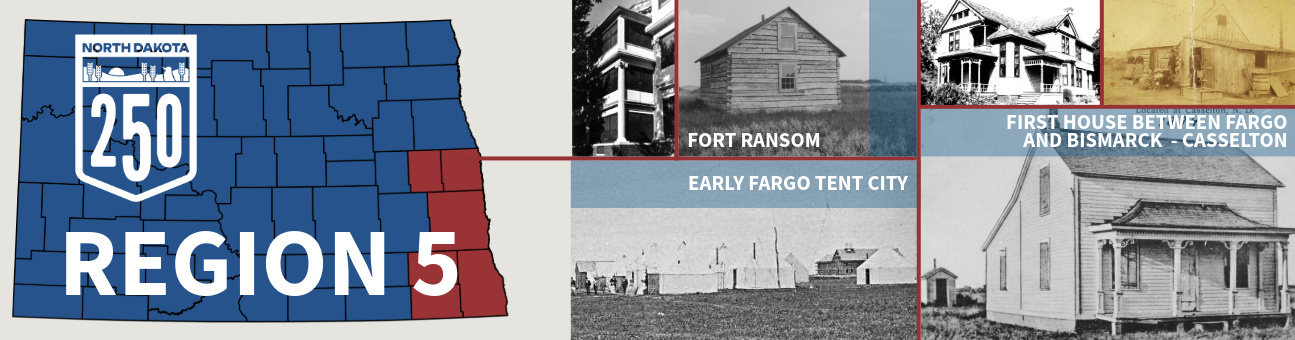
Tent cities traveled with the railroad because they were easy to assemble and could be moved quickly as the railroad developed. They existed because of the construction of the railroad and the building of the city of Fargo. The men that stayed in these cities were accustomed to hard living conditions, as tents did not keep heat very well in the cold area of Fargo.
The men that resided in these tents were originally located in “Fargo on the Prairie” but were banned and moved to “Fargo in the Timber.” They were construction workers and survey crews who were banned from residing in the limits of “Fargo on the Prairie” for their recreational activity which included: liquor, prostitutes, and more. Danbom, David B. and Claire Strom. Images of America Fargo North Dakota 1870-1900 , 2002, p 11.
The tents that the men lived in were mostly made of canvas. This canvas was either packed solely for the tent or was thrown from a covered wagon and over tree boughs to create a temporary living structure. The tents were handy for construction workers because they were able to move at a moment’s notice, especially with the construction of the railroad.
– Jenna Clawson, Digital History, 2012
Fargo, ND: Its History and Images NDSU Achieves - Historic Homes
Photograph from the 1899 "Fargo Blue Book"
Fargo attorney Samuel G. Roberts was one of the original six alderman of Fargo. It was in his office on April 12, 1875, that the city's officially elected government first met. Roberts was also a founder of the First National Bank - Fargo's first public bank, which opened in March 1878.
Roberts' home, originally built in 1882, was located at 202 Roberts Street. The house was moved (in two pieces!) in 1920 to 1115 South Eighth Street. In that year, Ruth Roberts married Gilbert Haggart (son of John Haggart, one the area's earliest settlers) and the Roberts home became (and still is) known as the Haggart house.
Fort Ransom Theodore Slattum Cabin - Built in 1879
Fargo-Moorhead Board of Realtors (1975). Fargo - Moorhead: a guide to historic architecture
Fargo 1879 - Holes Residence, 1233 Broadway
Originally the James Holes property extended from Twelfth to Fifteenth Avenues and from Broadway to the River. Mr. Holes brother had a parcel of land in Moorhead where the American Legion Hall now stands. Each man built a large brick home for himself, very similar in style, though only this one survives. John Prey, a carpenter from Ogdensburg, New York is credited with being the builder. Prey's designs were probably adapted from pattern books of the day. But, whatever the source, he certainly built
soundly-this building has double brick walls with a six inch air space between them!
Fargo 1895 - Hancock Residence, 718 Broadway
When an architect designs his own home, it is the best opportunity to display the services and talents he offers to the general public. Architect George Hancock designed his own home on fashionable Broadway and lived there for thirty years; though divided into apartments and with the front porch removed, it still retains great dignity through an ample site and numerous large trees. Hancock also designed the large "duplex" home to the south and the Thomas Baker residence which once stood on the site of the School of Nursing.
Fargo 1906 - Dibley Residence, 331 8th Avenue South
The Classical and Colonial Revivals at the turn of the century required white paint, wide porches with Greek columns, and balanced asymmetry. All are present here in this large home which must have had a wonderful view South along the river before construction of the protective levee. This home was built by F. E. Dibley, President of the Fargo Bridge & Iron Company.
Fargo c. 1910 - Monticello/Mount Vernon/Arlington, 711-719 Broadway
When large homes could no longer be easily maintained by single families, apartment buildings such as these were built to offer elegant in-town living without the burden of upkeep. In spite of its size, this building respects the scale of upper Broadway's older homes, while adding its own graceful rhythm. Each apartment has nine-foot ceilings and a screened porch; those on the top floor also boast skylights.
Fargo 1932 - Rue Residence, 1502 South 9th Street
Charles Rue, a contractor, built these three homes for himself and his two children. They are in the International Style brought from Europe in the 1920's. Le Corbusier, a Swiss-French architect and the principal exponent of the style, said that "the house is a machine for living" and attempted to incorporate the imagery of a machine technology in his residential work. Examples such as the Rue houses employ "pure" geometries and colors with no historically derived or extraneous ornament. The silt window and the use of glass block are among the cliches of the period.
Cal Olson Photograph Collection 2098
Fargo 1955 - "50+ year residents in Fargo are Mr. and Mrs. Chris Eide, shown on the porch of their tidy residence at 124 1st Ave. S. Presumably their house, one of many presentable structures in the urban renewal area, would not be razed in the clean-out program." - caption with image published in The Fargo Forum, September 4, 1955, p. A-14.